The Scaling Playbook: From Sales to a System
The shift from making listings to running an operation: doubling down on winners, batch workflows, the numbers that matter, and where your hours should go.
Somewhere between your tenth sale and your hundredth, the job changes. Early POD is a creation problem — make designs, make listings. Scaling POD is an allocation problem — you have signal now, and the question becomes where to point your limited hours. This playbook is about that shift.
Principle 1: feed winners, starve losers
Your sales data is telling you what the market wants from you specifically. Act on it mechanically:
- A design sells → expand it across products. Tee → sweatshirt, mug, poster, tote, digital print. Five new listings on a proven design outperform five new gambles. (Multi-product listings consolidate the demand — see that guide.)
- A niche sells → go deeper. One winning camping design means the niche wants you; publish the next five camping designs before exploring a new niche.
- A listing never sells → retire it after a fair test (a few months and a tag/mockup refresh). Dead listings clutter your shop's signal and your attention.
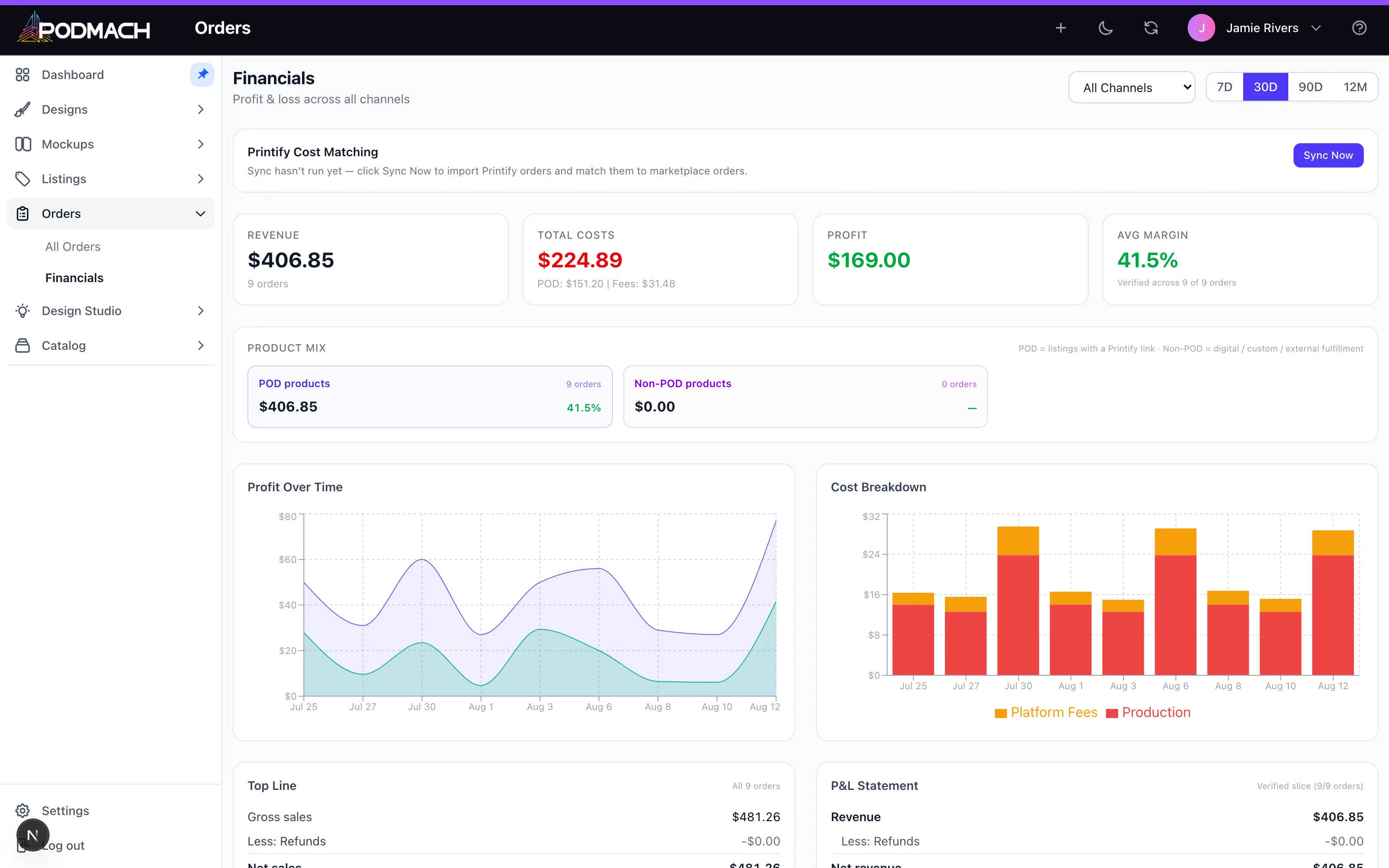
The monthly financials review (bottom ten by margin, top ten by revenue) is where these decisions come from. Fifteen minutes, once a month, in PODMACH's Financials.
Principle 2: batch everything
Context-switching is the silent killer of catalog velocity. The scaled workflow runs in batches:
- Design day: produce/commission 10–20 designs in one session, upload, name properly.
- Listing day: wizard runs back-to-back — mockup collections make image selection one click, MACH AI drafts every listing's copy, you make judgment edits only. Ten listings in an afternoon is a normal pace with the pipeline warm.
- Review day: monthly numbers, repricing, retirement, seasonal tag rotation.
Principle 3: know your three numbers
Scaling sellers can answer these without looking:
- Average realized margin per order (after ALL fees — from Financials, not from hope).
- Listings published per month — your catalog velocity, the input you control most directly.
- Revenue per listing per month — catalog quality. Rising = your niche/design selection is improving; falling while velocity is high = you're publishing filler.
Principle 4: buy back your hours
Your hour has a value now — roughly (monthly profit ÷ hours worked). Everything below that rate is a candidate for delegation or automation:
- Commission designs in your proven niches (marketplaces make this cheap) — you become the curator and publisher, not the illustrator.
- Let MACH AI carry the copy baseline; your editing pass is the high-value part.
- Let mockup collections and templates carry the visual consistency.
What never gets delegated: niche selection, pricing decisions, and reading your numbers. That judgment is the business.
Principle 5: diversify deliberately
In order of typical ROI once Etsy is working: deepen the Etsy catalog → add digital versions of art-forward winners → add your own store (Shopify/WooCommerce) with a traffic plan → build the email/social audience that makes your own store compound. (See Multi-Store Management for the operational side.)
The quiet truth about six figures
There's no trick listing. Shops at scale are almost always: hundreds of decent listings across a few proven niches × reasonable margins × months of compounding search rank × a weekly routine that never skips. The system is the success. Build the system.